Blog
Understanding New Hampshire Property Taxes Before You Buy or Own a Home

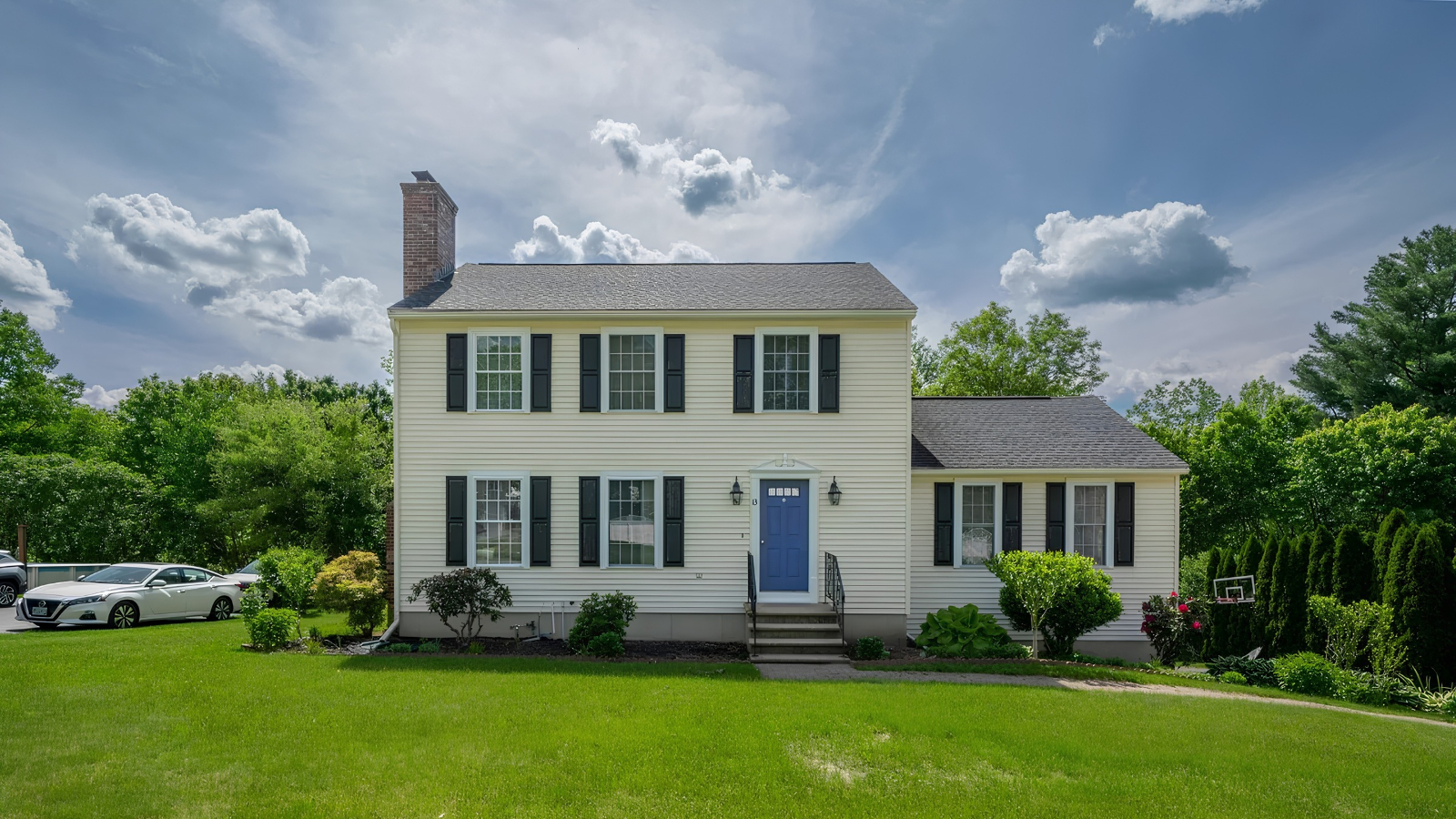
A home can look affordable on paper until you add the property tax bill. Two houses with similar asking prices may carry different annual taxes, and the difference can be large enough to change what feels comfortable in a monthly budget.
New Hampshire property taxes are also a source of confusion for longtime homeowners. Local assessors update property values, municipalities approve new tax rates, and homeowners may see higher tax bills even when their homes remain unchanged. Here is what buyers and homeowners in Southern New Hampshire should know, including how local rates work, what to check before closing, and where to turn if an assessment appears wrong.
Why your town makes such a difference
New Hampshire does not apply one combined property tax rate to every home. Each municipality raises revenue based on its approved spending needs, other available revenue, and taxable property values. Municipalities express the resulting property tax rate in dollars per $1,000 of taxable assessed value.
That local structure matters because Manchester’s budget, tax base, and school costs are not the same as Bedford’s or Merrimack’s. A town name on a listing is therefore only the beginning of the research.
Local assessors generally determine property values as of April 1, while New Hampshire’s property tax year runs from April 1 through March 31. Local assessing offices maintain individual property records. The New Hampshire Department of Revenue Administration oversees important parts of the system and publishes municipal rates, but a question about a particular house should usually begin with the town or city assessor.
What the money from property taxes pays for
A typical New Hampshire tax rate combines four pieces. The municipal portion helps pay for services such as roads, public safety, and town operations. The county portion supports county-level responsibilities. The local education portion helps fund school district expenses, while the state education portion reflects the statewide education property tax.
Education costs can make up a substantial part of the total. That does not mean two towns with different school tax rates offer a straightforward comparison of school quality.
On a final tax bill, look beyond the total rate. The breakdown can show whether a change came mainly from the municipal budget, education costs, county obligations, or some combination. You can find statewide figures in the Department of Revenue Administration’s municipal tax rate reports.
Your home’s assessed value is not its selling price
Many homebuyers mistakenly believe that municipalities calculate property taxes based on the price they pay for a home. They are not. The municipality uses a taxable assessed value, which may differ from both a home’s asking price and its eventual sale price.
An assessor considers property characteristics and local market evidence. Land, finished living area, condition, improvements, and other features can affect the result. A recent sale may provide useful evidence of value, but it does not automatically replace the town’s assessment with the transaction price.
Imagine a house listed for $575,000 with an assessed value of $490,000. A buyer should not assume that assessment will stay at $490,000 indefinitely. A future revaluation may change it, particularly if recent sales indicate that property values in the area have moved.
Before you rely on the tax amount shown in a listing, request the property record card. Check that the recorded square footage, finished basement, garage, additions, and other details match what is actually there.
How to work out an estimated annual tax bill
The basic calculation is simple.
Taxable assessed value ÷ 1,000 × total applicable tax rate = estimated annual property tax.
Suppose a home has a taxable assessed value of $450,000 and its applicable total rate is $20 per $1,000. Divide $450,000 by 1,000 to get 450, then multiply by $20. The estimated annual bill is $9,000.
For budgeting purposes, that works out to $750 a month. Many homeowners pay in instalments, while mortgage lenders often collect estimated taxes through a monthly escrow payment.

Understanding property tax calculations helps New Hampshire homeowners estimate their annual housing expenses.
Use this calculation as a planning tool, not a guarantee. When estimating the total cost of a home, the mortgage calculator can help you consider taxes alongside the mortgage payment and insurance.
A closer look at property taxes around Southern New Hampshire
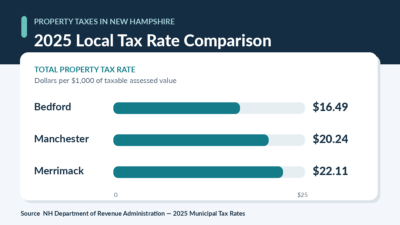
A comparison of 2025 property tax rates in Bedford, Manchester, and Merrimack per $1,000 of assessed property value.
To put the differences into perspective, the following figures are the published 2025 total municipal rates. The municipality expresses property tax rates in dollars per $1,000 of assessed property value. They are historical reference points, not confirmed 2026 rates.
The figures come from the Bedford Assessing Office, Manchester’s official tax rate information, and Merrimack’s tax rate history.
These examples deliberately use the same taxable assessment to illustrate the calculation. They do not mean a $500,000 home in each community would actually have an identical assessment. Home prices, valuation practices, and property characteristics differ.
A buyer comparing homes in these towns should ask for each property’s latest final bill rather than ranking towns by tax rate alone. A lower rate on a substantially higher assessment can still produce the larger tax bill.
Why reassessments deserve attention in 2026
Tax rates are only half the story. The taxable value to which those rates apply can change, especially during a municipality-wide reassessment.
Bedford’s assessing office reports a 2026 revaluation, with a median increase of about 18% for residential assessments. Merrimack also reports a town-wide value update for 2026 intended to bring assessments closer to market value as of April 1.
Those developments do not mean every property owner’s final tax bill will increase by the same percentage. A municipality can adjust its rate as the overall tax base changes. Changes in a property’s assessed value compared with other properties, along with the amount of revenue the municipality needs to raise, partly determine how much a homeowner pays in property taxes.
Check the property details and any instructions for an informal review. The Bedford Assessing Office and Merrimack Assessing Department publish information for affected owners. Buyers considering a property during a revaluation should ask how the new figures may affect their estimate.
When Homeowners Receive and Pay Property Tax Bills
Many New Hampshire communities send two property tax bills each year. Municipalities typically calculate the first installment using earlier tax information. Once they finalize the annual tax rate, they adjust the later bill to reflect the actual amount owed, accounting for the first installment.
Manchester generally mails its first property tax bill in late May or early June and requires payment approximately 30 days later. Merrimack ordinarily has installments due around July 1 and December 1. Dates and billing arrangements can vary, so check the tax collector’s current instructions for the community where the property is located.
If you pay through a mortgage escrow account, your lender estimates the annual amount and collects money throughout the year. When taxes change, the lender may adjust the escrow payment.
After buying a home, verify that the municipality has your correct mailing address.
What to investigate before making an offer
A property’s tax history should be part of the early conversation about affordability, not something left until the closing appointment.
Begin with the most recent final tax bill and current property record card. Then ask whether a revaluation is underway or whether substantial improvements may not yet appear on the assessment. A newly finished basement or addition could change future taxable value.
Next, consider whether the seller receives an exemption or credit. Do not treat the seller’s net bill as a promise of what you will owe.
Finally, run the entire monthly housing budget. Principal, interest, insurance, property taxes, possible association dues, maintenance, and utility costs all matter. A home with a slightly higher asking price may still have a manageable overall payment, while a less expensive property could stretch the budget because of its taxes and other carrying costs.
The buyer resources offer a broader look at preparing for a purchase and understanding the steps leading to closing.
When a home changes hands, the closing professional typically divides the property taxes between the buyer and seller based on their respective ownership periods.
Because the tax year and billing dates do not always line up neatly with a closing date, you may see an adjustment or credit on your settlement statement. Some calculations use estimated figures when the final annual bill is not yet available. Ask the closing professional how they calculated the tax adjustment and whether the agreement requires any later reconciliation.
Buyers should also confirm that the seller has paid any outstanding property taxes and resolved any related liens before ownership transfers. If the lender requires an escrow account, the funds collected to start that account are separate from the buyer-and-seller tax proration.
Tax exemptions and relief programs homeowners should review
Not every homeowner pays tax on the full assessed value. New Hampshire provides exemptions and tax credits for certain eligible residents, although the rules and available amounts vary.
An exemption generally reduces the taxable assessed value. A tax credit reduces the amount of tax owed. Programs may be available to qualifying older homeowners, veterans or surviving spouses, people with certain disabilities, and owners with qualifying energy systems. Some benefits depend on the municipality’s adoption of an optional program.
For many property tax exemptions and credits, the application is Form PA-29, filed with the local municipality by April 15 for the relevant tax year. Eligibility requirements and additional documentation vary. The state’s current forms page is a sensible place to start, followed by a conversation with the local assessor.
There is also a state-run Low and Moderate Income Homeowners Property Tax Relief program. For the 2026 application period, the published adjusted gross income thresholds were $37,000 for single homeowners and $47,000 for married homeowners or heads of a New Hampshire household, alongside other eligibility requirements. The New Hampshire Department of Revenue Administration accepted applications from May 1 through June 30, 2026, for the relevant prior-year property taxes.
Eligibility rules and filing periods can change. Homeowners should consult the Department of Revenue Administration’s relief guidance rather than assume that a previous year’s rules still apply.
What you can do when an assessment seems wrong
An assessment that rises is not necessarily an incorrect assessment. Still, if the property record lists a feature that does not exist or the value seems out of line with comparable properties, you have options.

Reviewing property assessment records can help homeowners identify errors before requesting an abatement.
Start with the assessing office. Request the property record, identify specific discrepancies, and ask how the local assessor determined the property’s value. Recent comparable sales and reliable property details can help make the discussion more productive.
If the issue is not resolved, New Hampshire has a formal abatement process. Under the usual schedule, the municipal application is due by March 1 following the final tax notice, or within 60 days after a late bill, whichever deadline applies. Municipalities generally have until July 1 to respond, and appeals are ordinarily due by September 1. Exceptions and procedural requirements matter, so verify dates for your circumstances before filing.
An abatement is not simply a request for a lower bill. It generally requires a reasoned case that the assessment or taxation is improper or disproportionate. The state’s assessing reference manual explains the process in more detail.
Keeping property taxes manageable over time
You cannot control every change to a municipal budget or local housing values. You can, however, avoid treating the annual bill as a surprise.
Set aside money throughout the year if you do not use escrow. Review new assessment notices while there is still time to ask questions. Check the final bill against the prior year’s assessment and rate, and keep records of improvements, appeals, and any exemptions you receive.
Homeowners considering a sale should also remember that assessed value and likely selling price answer different questions. The town’s number is for taxation; a market analysis considers competing listings, recent comparable sales, condition, and current buyer demand. The home value resource offers a starting point for that separate conversation.
Questions homebuyers often ask about New Hampshire property taxes
Does New Hampshire have one property tax rate for the entire state?
No. Communities have different combined rates made up of municipal, county, and education portions. A parcel may have additional district taxes. Use the rate applicable to the specific address.
Will buying a home automatically raise its assessment?
A sale does not, by itself, mean the assessment automatically becomes the sale price. However, new sales information can inform future assessments, and town-wide revaluations or changes to property characteristics can affect the number.
Does Your Mortgage Payment Include Property Taxes?
Sometimes. If your loan has an escrow account, the lender generally collects an estimated amount with each monthly payment and pays the tax collector when bills come due. Without escrow, you must make the payments directly.
Can homeowners deduct property taxes on federal tax returns?
Qualifying real estate taxes may be deductible if you itemize, subject to federal requirements and limits. The IRS guide for homeowners explains the rules. Ask a qualified tax professional how they apply to your return.
Is the town with the lowest rate always the less expensive choice?
No. The final bill depends on taxable assessed value as well as the applicable rate. Purchase price, insurance, commuting costs, and ongoing upkeep also influence what a home costs to own.
The number worth looking at before you decide
Property taxes are not a minor detail in a Southern New Hampshire home search. They can affect the monthly payment, the amount held in escrow, and how comfortably a home fits into a long-term budget.
The useful comparison is not simply which town has the lowest rate. It is what a particular home costs to own today, what might change, and whether that cost works for your plans. Reviewing the actual tax bill and assessment early gives you room to ask better questions and make a decision with fewer surprises.
For buyers weighing homes across Manchester, Bedford, Merrimack, and nearby communities, Sudip Pant can help put property-specific costs into the context of local housing options, while municipal assessors and qualified tax advisers can address questions about assessments and tax liability.